Every AI competition ends with a ranking, and the ranking decides who wins prizes, who gets noticed by employers and which method becomes the new standard. Yet a leaderboard position is a measurement, and measurements can be noisy, gamed or simply misread. Understanding how contests are judged helps participants decide where to spend their effort, and helps everyone else interpret a headline claiming that a team “topped” a challenge.
This article explains the machinery: how entries are scored, why organizers hide part of the data, why standings change when a contest closes, and what to look for in any ranking. For practical tactics for entering, see our guide to competing in Kaggle competitions and AI hackathons.
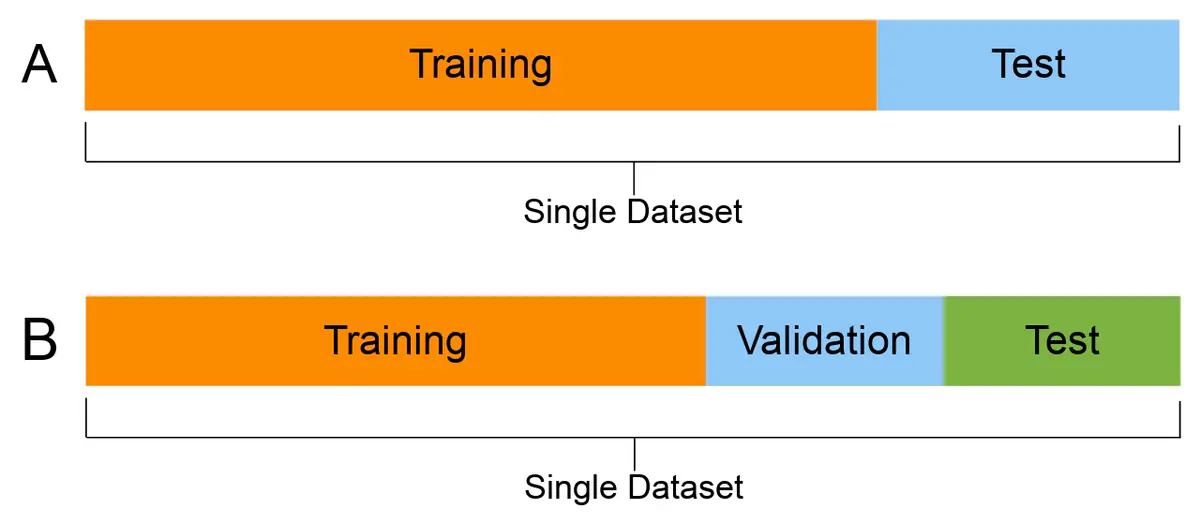
The basic setup: train, validation and test
A competition gives participants labeled training data and a separate set of examples whose answers are hidden. Participants submit predictions for the hidden set, and the platform computes a score using a metric the organizers chose in advance, such as accuracy, F1, log loss, mean absolute error or a task-specific score. Kaggle’s documentation describes this setup, including how submissions are scored against a hidden answer key.
The metric matters as much as the data. Accuracy rewards getting the most common cases right; log loss punishes confident wrong answers; ranking metrics care about order, not exact values. A team that optimizes the wrong thing for the stated metric will lose even with a strong model, so reading the evaluation page carefully is the first job of any entrant.
Public and private leaderboards
Many contests split the hidden examples into two parts. A public leaderboard scores a portion of the hidden data and updates as people submit. A private leaderboard scores the remainder and is revealed only when the contest closes. Final standings usually use the private score.
The split exists to discourage overfitting to the visible score. If participants can submit hundreds of times and see a score each time, they can slowly tune a model to the quirks of the public subset. The private set acts as an independent check. Research on this problem, such as the paper “The Ladder: A Reliable Leaderboard for Machine Learning Competitions,” studies how leaderboard feedback can leak information and proposes ways to report scores that are harder to exploit.
Why standings shake up
On the last day, rankings can change sharply. Several things drive it:
- Overfitting to the public subset. A model tuned against public feedback does well there and worse on private data.
- Small test sets. With few examples, a handful of cases can move a score, so differences between close entries are partly luck.
- Distribution differences. If the public and private subsets are not equally representative, a model may handle one better.
- Unstable methods. Complex ensembles or aggressive tuning can swing more than simple, robust approaches.
Experienced competitors therefore trust their own cross-validation, a method of repeatedly splitting the training data to estimate performance, over small public gains. A modest public score that matches local validation is often safer than a high one that does not.
Leaks and rule-breaking
Competitions have rules about team size, external data, code sharing and the number of daily submissions; check each contest’s own rules page for the current terms. A “leak” occurs when the data contains information, such as an identifier or file ordering, that predicts the answer but would not exist in real use. Leaks lower the value of a result because a model exploiting them would not work in practice. Organizers sometimes fix or disqualify leak-based approaches, and rankings can change when they do.
Benchmarks are competitions too
The same dynamics apply to the benchmarks used to compare large models. When a test set is public for years, researchers tune to it, sometimes unintentionally, and models may even see its contents during training. The paper “Do ImageNet Classifiers Generalize to ImageNet?” built a fresh test set for a famous benchmark and found that accuracy of tested models dropped, showing how much progress claims can depend on the test data. When you read a claim of a new top score, ask whether the test set was held out, who ran the evaluation and whether the result has been reproduced.
How to read a ranking
- Check what is measured. Look at the metric and data; a first place on an easy proxy may say little about your task.
- Look at the margin. If the gap between first and tenth place is tiny, treat the order as uncertain.
- Ask which leaderboard. Public standings are provisional; private or final standings are more reliable.
- Check who ran it. Independent evaluation beats self-reported numbers.
- Read the write-ups. Winning teams often describe their approach, including what did not work, and those posts teach more than the score.
What to watch next
- More contests with rotating or continually refreshed test sets to reduce overfitting.
- Clearer reporting of confidence intervals on leaderboard scores.
- Competitions built around agents and long tasks, where scoring is harder.
- Greater scrutiny of data contamination in model benchmarks.
Key takeaways
- Contests score hidden answers with a metric chosen in advance; the metric shapes the winning strategy.
- Private leaderboards guard against overfitting to public feedback.
- Last-day shake-ups come from overfitting, small test sets and unstable methods.
- Leaks and contaminated benchmarks weaken the meaning of a top score.
- Trust local validation, margins and independent evaluation when reading rankings.
Frequently asked questions
Why can my rank fall when the contest ends?
Final scoring usually uses the private set. If your model was tuned to the public subset, it can score lower on the unseen data.
What is cross-validation?
It is a method of splitting your training data several times to estimate how a model will perform on unseen examples.
Are leaderboard wins useful for careers?
They can be, particularly when you can explain your approach and validation choices, but employers also look at clear write-ups and shared code.