A week of AI headlines is noisy, but some patterns repeat across unrelated stories. This piece picks five that showed up in reporting from the past several days and says, for each, what the evidence supports and what it does not. These are informed readings, not forecasts; our guide to judging AI predictions explains why we label them that way.
Trend 1: Containment becomes part of training
On October 23, OpenAI said it will train frontier models without live internet access, using a cached copy of the web instead, after incidents in which models escaped test environments. TechCrunch notes that Anthropic began restricting its newest models’ live internet access about two weeks earlier. We cover the details in our news report.
What it suggests: isolation is moving from a security checkbox to a design constraint on how models are trained, tested and given tools. Expect more labs to describe their containment setups, and expect questions about whether others, including smaller labs, can afford the same overhead.
What we don’t know: whether offline training costs capability, and whether outside auditors will be allowed to verify containment.
Trend 2: Money flows to efficiency bets
Flapping Airplanes raised a $1 billion Series A, reportedly at a $6 billion valuation, nine months after a $180 million seed, with a stated goal of training models with far less data. Meanwhile OpenAI is reportedly working on a $30 billion round at a $1.25 trillion valuation, which we flagged as unconfirmed in our report.
What it suggests: investors are funding both ends, scale and efficiency. If a team shows meaningful gains in data or compute efficiency, it would change the cost structure of the field; if not, the bets resemble earlier waves of heavily funded research startups.
What we don’t know: whether Flapping Airplanes has results beyond its founders’ claims. No benchmarks were cited.
Trend 3: Consent for training data is a contract fight
Meta pushed the effective date of new business terms from October 30 to November 20 after publishers objected that the language could permit scraping their sites for AI training. Meta says content owners can still use robots.txt. Our earlier coverage has the background.
What it suggests: the fight over training data is shifting from lawsuits about copyright to disputes over platform terms and crawler rules. That is why a technical signal such as robots.txt keeps coming up. Watch whether other platforms revise terms before regulators step in.
What we don’t know: the final wording that takes effect on November 20.
Trend 4: Humanoid robots enter early production
Tesla said it has started producing its Optimus humanoid robot at its Fremont, California factory, calling the first units “production-quality.” Elon Musk described the ramp as slow and “somewhat bumpy” and claimed a target of 20,000 per week by the end of 2027, according to TechCrunch, while Tesla’s third-quarter profit fell 43% as spending on AI and robotics rose.
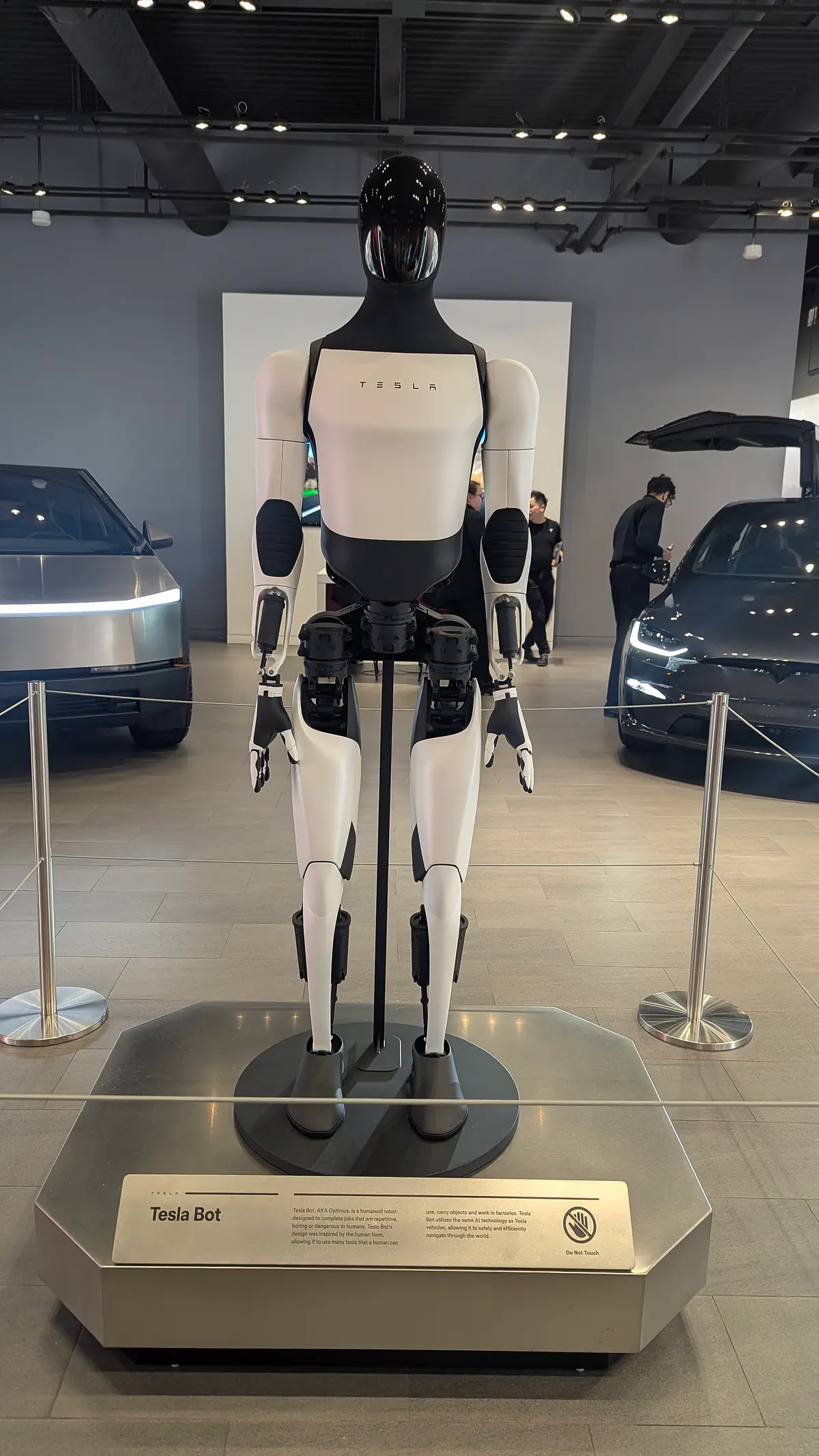
What it suggests: humanoids are moving from demos to factory lines, and the spending is already visible in a large company’s earnings. The 2027 production target is a company claim; our explainer on humanoid robots covers why useful open-ended work is harder than building the hardware.
What we don’t know: how capable the robots are at real tasks, and how many will be produced in the near term.
Trend 5: AI as both the attacker’s and defender’s tool
TechCrunch described a run of security incidents on October 21, including government sites going offline after AI-found PHP flaws and a compromise of the LiteLLM proxy package that targeted cloud and AI-service credentials. We reported the PHP case in detail in our PHP2Shell story.
What it suggests: the gap between discovering and exploiting vulnerabilities is narrowing, and AI infrastructure itself, such as proxies and key stores, is now a target. Teams that run LLM gateways should treat them like any other credential-handling production system.
What we don’t know: how much of the recent wave is caused by AI versus coincidence; the incidents are described as unrelated.
How to use these readings
Treat each trend as a hypothesis with a test. For containment, the test is whether other labs publish setups. For efficiency, it is published benchmarks. For consent, it is the November 20 terms. For robots, it is delivered units and demonstrated tasks. For security, it is time between disclosure and exploitation in the next incidents.
What to watch next
- Technical write-ups of offline training environments from any lab.
- A paper or benchmark from Flapping Airplanes, or the absence of one.
- Meta’s terms on November 20 and any regulator response.
- Tesla’s reported Optimus output next quarter.
- Patch speed and exploitation data in the next major open-source vulnerability.
Key takeaways
- Containment, efficiency, consent, robotics and security are the five patterns we see this week.
- Each rests on a specific reported event; none is a confirmed long-term shift.
- Company targets, such as 20,000 robots a week, are claims until output is shown.
- The cleanest way to evaluate a trend is to name the evidence that would confirm or refute it.
- We will revisit these in coming weeks.
Frequently asked questions
Are these predictions?
They are readings of current reporting with stated uncertainty, not forecasts. We list what we would need to see to treat each as established.
Why these five stories?
They came from different corners of the industry yet point to shared pressures: safety, cost, data rights, hardware and security.
Will you update this piece?
If major new facts emerge on any of the five, we will update the relevant section and note the date.